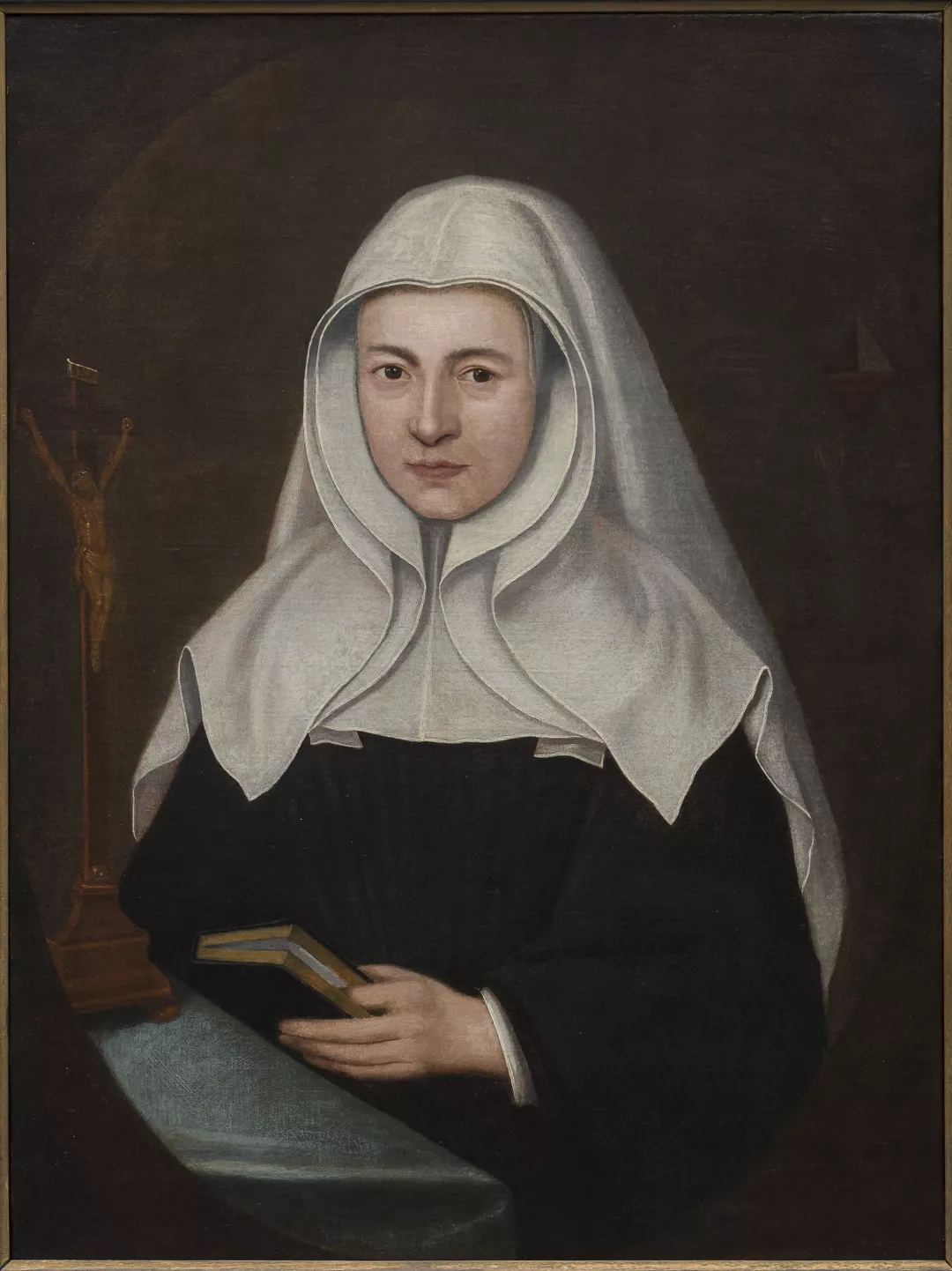
A Beguine from the Vossius family
Anonymous painter – 1722, Oil on canvas (Art Collection of the Province of Limburg)
The Vuskens or Vossius family is a prominent family from Hasselt. Many women from that family are Beguines here. You can see a young woman with her prayer book. What might be going through her mind?
I, a beguine in Hasselt
Poor women or rich ladies, young girls or old widows: every one of them can join the beguines. Even so, certain conditions apply. A beguine must be pious and chaste. During her first year at the beguinage, the novice learns to behave like beguine. Those who enter pay a contribution. Most of Hasselt's beguines came from wealthy families, including the young woman in the painting in this room. She is one of the daughters of the Vossius family who entered the beguinage at a young age. But poorer women who had to work for a living also resided here. Faith brings them together. Some women have their own reasons for choosing this existence. A life as a beguine offers more independence than marrying or entering a convent. That's because, unlike nuns, beguines can retain their own property, occasionally leave the complex, and even quit the order.
Beguine Vossius' Habit with Hood
Céline Lambrechts - 2026, hand-spun yarn, hand-woven linen.
This hooded habit was inspired by the traditional dress of an 18th-century Hasselt beguine. The habit worn by the young beguine Vossius in the painting in this room served as the starting point for this piece. Only natural and local materials were used: wool from native sheep, and linen from flax. These materials have strong ties to our textile history and were also worked by the beguines to produce textiles for everyday use. In fact, wool and flax processing provided the foundation for many beguines to live economically independent lives. Céline Lambrechts returned to these historical crafts: the yarn is spun by hand, and the textiles are woven by hand on a loom. The habit was then fulled: a traditional technique in the cloth industry in which the woollen fabric is felted into a dense and sturdy cloth fabric.
Céline Lambrechts (b. 1997, Lier) is a textile designer based in Lier, with a background in interior design. She specialises in hand-woven (interior) textiles made from local yarn.
Ritual
Ingel Vaikla - 2026, Colour HD video, no sound, 1'35", loop.
This silent scene captures a tender moment of care: a young beguine is carefully dressed by an older member of the community. The intimate exchange unfolds through a shared ritual, in which the tactile habit of the Beguine — made by textile artist Céline Lambrechts — plays a key role.
Ingel Vaikla (b. 1992, Tallinn) is a Brussels-based audiovisual artist working with video, 16 mm film and found footage. One of the central themes in her artistic work is the representation of place in relation to communities. She seeks to create a visual language that conveys the existential, conceptual and ideological qualities of a place.
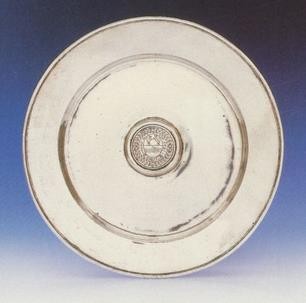
Plate
François Morren – 1623, Silver (Het Stadsmus Collection)
Can you see the Vuskens family coat of arms? For Margareta Vuskens, her entry into the Hasselt beguinage was a special moment. During her profession, she received a consecrated cloth and a profession crown. That crown was carried into the church on a dish – perhaps this one. On the reverse side is inscribed: MARG. VUSKENS BEG. ECLI(SI)AE BEGINAGIJ IN HASSELT DEDIT A° 1623. On the front, beneath the coat of arms, Vossius’s motto is inscribed between the year: ANNO CAVTE 1623.
